

Leveraging Artificial Intelligence in Clinical Practice
Scientists and cardiologists are collaborating to use artificial intelligence (AI) in the treatment of people with cardiovascular disease.
Mayo Clinic is at the forefront of deploying AI tools and technologies in clinical practice to help patients with heart disease or those at risk of developing it. The clinic’s AI Cardiology team uses these new technologies for early risk prediction and to diagnose complex heart conditions. People receiving cardiac care at Mayo Clinic’s Department of Cardiovascular Medicine can benefit from the availability of leading research and expertise in AI for cardiology, which is dedicated to improving patient care.
Artificial intelligence refers to intelligent technologies that are managed automatically. It touches nearly every aspect of modern life, including medicine. At Mayo Clinic, AI is used to program computers. This is done to process data and respond to it quickly and consistently in order to achieve better treatment outcomes.
Applications of AI include faster detection of heart disease and stroke, and improved efficiency in diagnostic imaging. For example, a Mayo Clinic study applied artificial intelligence (AI) to a new screening tool for a type of heart condition that doesn’t have obvious symptoms. This condition is known as left ventricular dysfunction. The AI-powered screening tool identified individuals at risk of developing this condition in 93% of cases. To put this into perspective, a mammogram is accurate in 85% of cases. Furthermore, AI developed by Mayo Clinic is being used in Apple Watches to detect reduced heart pumping power (reduced ventricular ejection fraction).
These technologies complement the knowledge of physicians. Essentially, by combining direct care with data analysis, AI in cardiology allows physicians to spend more time with their patients and improve collaborative decision-making.
Some basics: Artificial intelligence is the ability to make computers or machines learn to solve problems that would otherwise require human effort. Advances in computing power have made it easier to analyze large amounts of data quickly, consistently, and accurately. This has enabled healthcare professionals to use artificial intelligence (AI) on massive and complex datasets in a way that improves decision-making, diagnosis, and treatment by identifying patterns in patient data.
The fundamental unit of an AI system is the neural network. For example, a computer system is trained by absorbing and analyzing hundreds of thousands of similar reading sets. The computer then becomes saturated with experience in analyzing a given issue, such as an electrocardiogram (ECG). The result is an AI system that can interpret a simple test, detect a cardiac condition, and predict potential future problems.
Mayo Clinic leaders have identified several areas where AI could be leveraged in healthcare. Mayo Clinic is well-positioned to advance AI because its long history of caring for vast numbers of patients has provided it with a massive database of historical genomics, microbiology, ECGs, diagnostic images, and other test results. This, coupled with the clinic’s strong culture of close collaboration among physicians, engineers, and scientists, contributes to the expansion of AI use in healthcare in beneficial ways.
You can take a more detailed look at computer neural networks and deep learning (strong AI) here.
From Research to Clinical Practice
Cardiovascular physicians and scientists at Mayo Clinic are combining AI with clinical practice for better care. Here are three examples that have moved from research to clinical use:
Helping stroke patients. In the emergency room, when patients have a type of stroke called an intracerebral hemorrhage, they undergo a CT scan. This scan is then analyzed using a computer trained to interpret the CT data. This method has proven effective in reducing the time it takes to diagnose the stroke and minimizing brain damage.
Preventing heart problems. The use of artificial intelligence (AI) in electrocardiography (ECG) has led to the development of low-cost tests that can be widely used to detect weakened heart pumping power, which can lead to heart failure if left untreated. Mayo Clinic is well-positioned to advance AI in this field, thanks to its database of more than 7 million ECG scans. First, all personally identifiable information is erased to protect patient privacy. This data can then be analyzed to predict heart failure accurately and quickly.
Early detection of atrial fibrillation. AI-guided ECG scans are used to detect this heart rhythm disorder before any symptoms appear. This heart rhythm disorder is also known as atrial fibrillation.
Collaboration leading to innovation
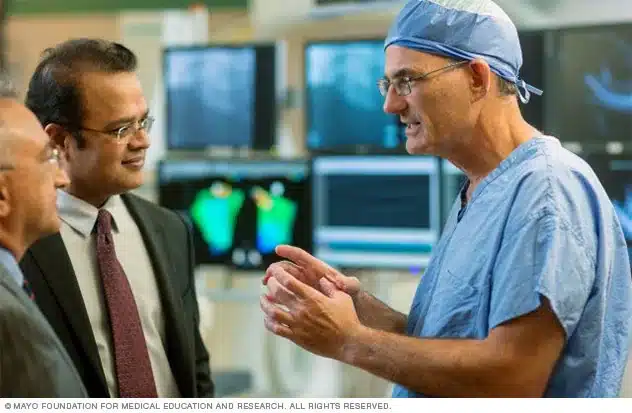
Mayo Clinic experts in the Cardiac Electrophysiology Lab
Team approach
A physician (right) collaborates with a colleague in the Cardiac Electrophysiology Lab to interpret a test result.
The field of AI is experiencing rapid growth in healthcare thanks to the collaborative efforts of experts. Mayo Clinic has implemented proven methods across various medical and surgical specialties to improve clinical care services.
Source :
https://www.mayoclinic.org/ar/departments-centers/ai-cardiology/overview/ovc-20486648